

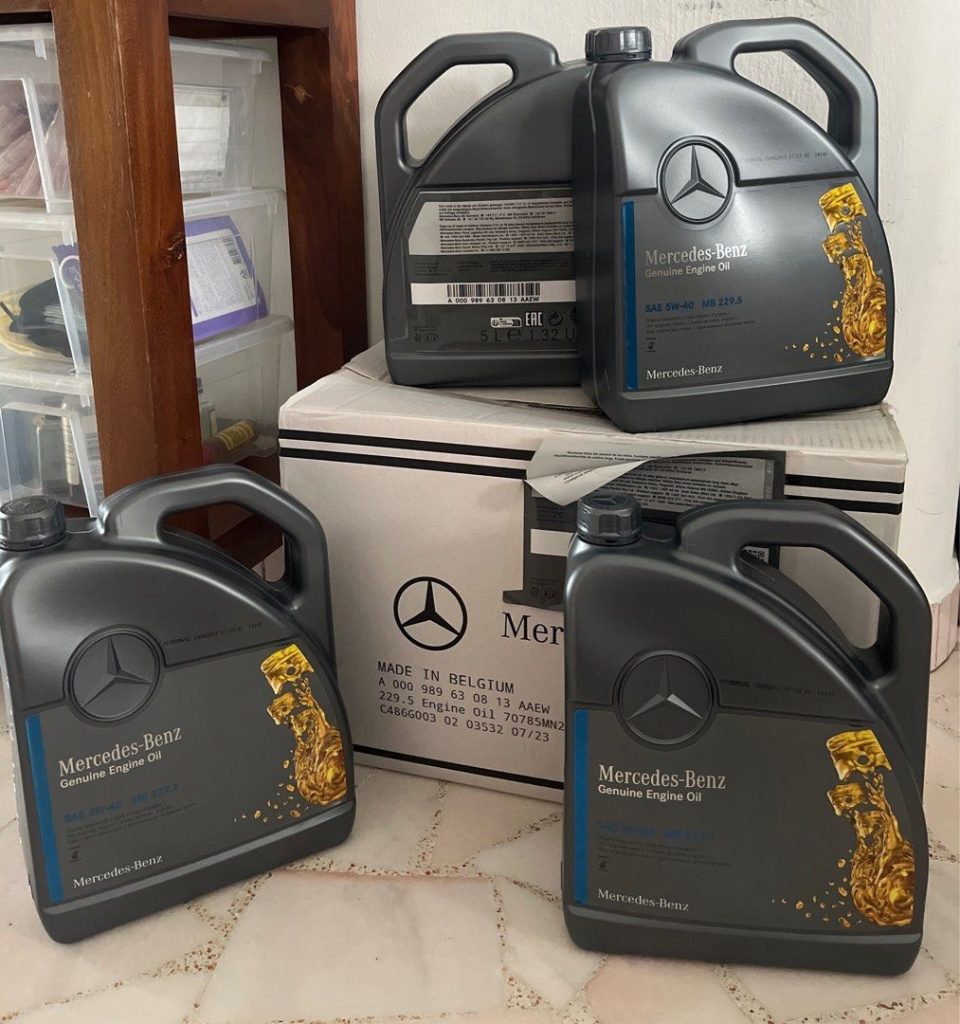
Walk into any parts shop and you’ll find four Mercedes oil approvals that look almost identical: MB 229.5, 229.51, 229.52 and 229.71. They are not interchangeable. The wrong one can foul a particulate filter, thin out the oil film in an engine that needs a thicker one, or put your warranty at risk.
This guide explains what each specification is, why people mix them up, and how to find the right one for your engine.
The Four Specifications Explained
First, two terms. HTHS (high-temperature, high-shear viscosity) measures how well an oil keeps its protective film under heat and load. SAPS stands for sulphated ash, phosphorus and sulphur. These are the oil additives that leave residue behind and can clog exhaust filters. “Low-SAPS” means less of that residue.
MB 229.5
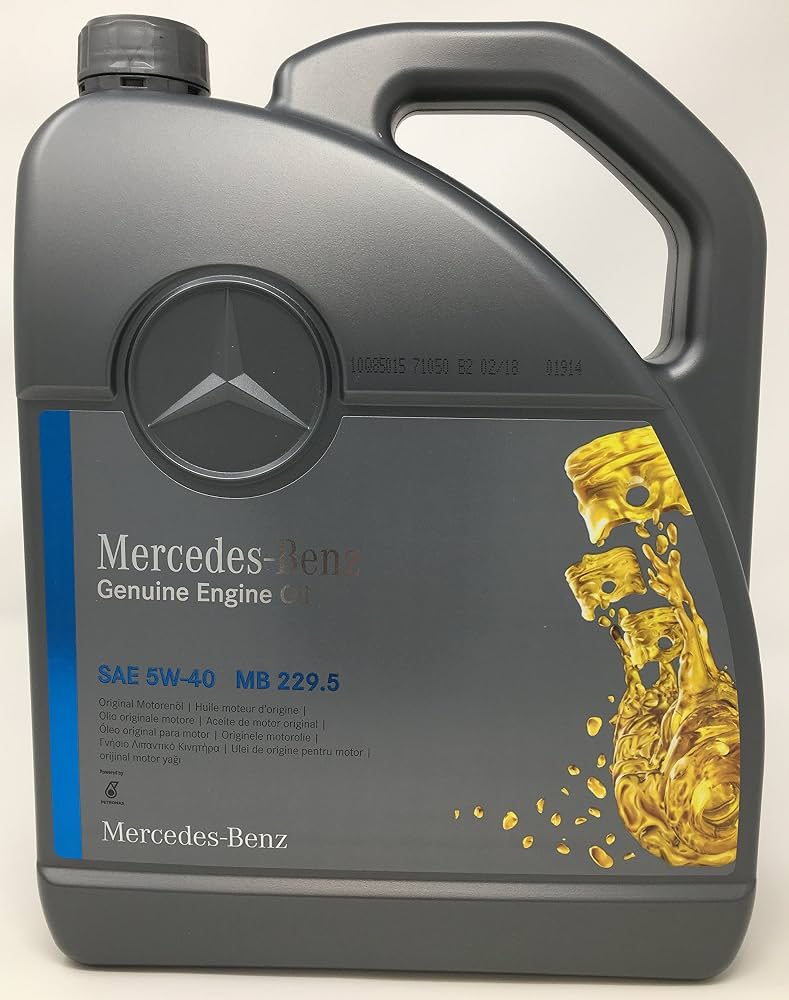
A high-performance, fully synthetic, long-drain approval for petrol and diesel engines. It replaced 229.3 around 2002.
- Designed for: petrol engines and older diesels without a diesel particulate filter (DPF). Examples include the M272/M273, M271, M276 (in many markets), AMG V8s and OM646/OM648-era diesels.
- Key properties: HTHS of at least 3.5 mPa·s and full-SAPS, with a maximum ash content of about 1.6%.
- Typical viscosities: 0W-40, 5W-40, 5W-30.
- Filter-safe? No. The ash content is too high for particulate filters.
MB 229.51
A low-SAPS approval created for diesel engines with DPFs (Euro 4/5). It can also be used in petrol engines whose manual lists it.
- Designed for: Euro 5 DPF diesels such as the OM642 (V6) and OM651 (4-cylinder).
- Key properties: HTHS of at least 3.5 mPa·s, sulphated ash of about 0.8% maximum, phosphorus about 0.09% maximum and sulphur about 0.3% maximum.
- Typical viscosities: mostly 5W-30, occasionally 0W-30 or 5W-40.
- Filter-safe? Yes.
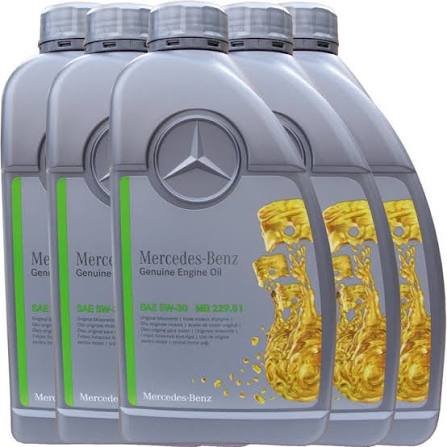
MB 229.52

ewer low-SAPS approval with stricter requirements for fuel economy, oxidation, deposits and exhaust aftertreatment compatibility. It targets Euro 6 diesels and later BlueEFFICIENCY engines.
- Designed for: Euro 6 OM651, early OM654, and petrol engines with particulate filters whose manual calls for it.
- Key properties: HTHS of at least 3.5 mPa·s and low-SAPS.
- Typical viscosities: 5W-30 almost universally, sometimes 0W-30.
- Filter-safe? Yes.
One point of clarification: 229.52 is often described as having a lower ash limit than 229.51, but both are generally cited at about 0.8% maximum. The real difference is the tougher performance testing, not the ash.
MB 229.71
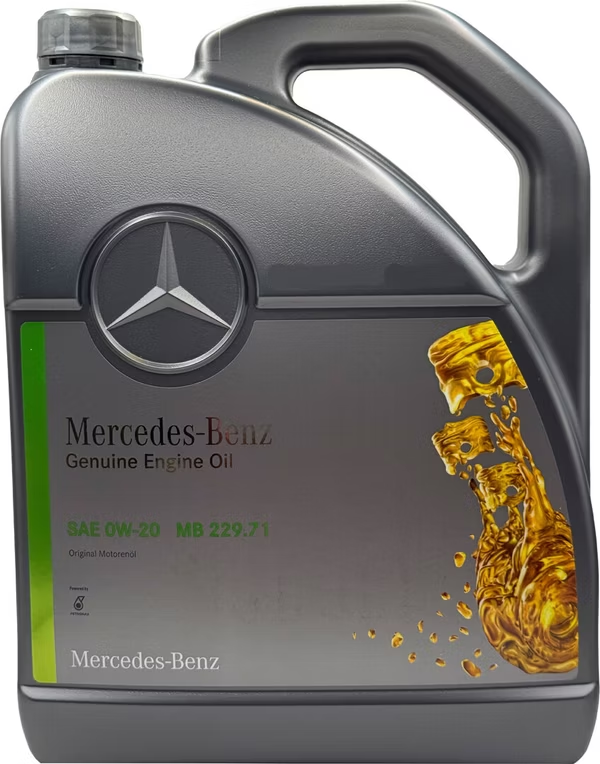
The newest approval, a thin 0W-20 oil aimed at fuel-economy and CO₂ targets. It is low-SAPS, so it is also kind to filters.
- Designed for: engines built around 0W-20, such as the M254 and M256 petrols and OM654/OM656 diesels. Confirm by engine code and build date.
- Key properties: a lower HTHS of about 2.6 mPa·s, compared with 3.5 mPa·s for the other three.
- Viscosity: 0W-20 only.
- Backward compatible? No. It is not approved for older engines, which were designed for oils with an HTHS of 3.5 mPa·s or higher.
Why They Get Confused
- Sequential numbers. People assume 229.71 beats 229.52, which beats 229.5. It doesn’t. Newer does not mean better for your engine, and 229.71 is a separate line for thin-oil engines, not a replacement for the others.
- Multiple approvals on one bottle. A label reading “229.51 / 229.52” looks like an upgrade path, but it simply means the oil meets both sheets.
- “Suitable for” is not “approved.” Look for the exact phrase “MB-Approval 229.xx” or “Meets MB 229.xx”. Wording such as “suitable for” or “exceeds” is not an approval. Vague labels like “5W-30 Mercedes approved” don’t tell you which sheet the oil meets.
- One-way supersessions. In common DPF and low-SAPS usage, 229.5 gives way to 229.51, then 229.52. 229.51 and 229.52 can generally go where 229.5 is called for, but it does not run the other way. Always check your manual.
What Happens If You Use the Wrong Oil
Short term, you may notice:
- Lower fuel economy (thicker oil in a 229.71 engine) or higher oil consumption (thinner oil in an older engine)
- Changes in cold-start behaviour and valve-timing response
- Dash warnings or ECU adaptations
Long term, the risks include:
- Bearing, cam and cylinder wear
- DPF or GPF clogging
- Turbo oil film breakdown
- Higher deposit formation
- Voided warranty or goodwill coverage
229.5 in a DPF diesel. The extra ash leaves non-burnable residue in the filter. That means more frequent regenerations, fuel dilution of the oil, and eventually a clogged or failed DPF, which is an expensive replacement.
229.71 in an older engine. The oil film is too thin for a design validated on higher-HTHS oil. Expect higher consumption and more wear under load or heat, and because the engine isn’t approved for it, your warranty is exposed.
Any non-approved oil in a Mercedes also brings unknown additive packages and a higher risk of sludge or catalyst contamination.
How to Find What Your Engine Needs
- Owner’s manual. The operating fluids section lists the sheet number, for example “MB 229.52”.
- Oil filler cap. It usually shows the sheet number, but older caps can be outdated, so cross-check against the manual.
- Mercedes BeVo database (bevo.mercedes-benz.com). Look up by VIN or engine code and search the approved oil list by brand.
- If the original spec is discontinued, use the current approval Mercedes names as its replacement. Don’t guess from viscosity.
Practical Recommendations
| Engine type | Typical spec | Typical viscosity |
|---|---|---|
| Older petrol (no filter) | 229.5 | 5W-40 / 5W-30 / 0W-40 |
| Petrol with GPF (mid-generation) | 229.5 or 229.52, per manual | 5W-30 |
| Euro 5 DPF diesel (OM642, OM651) | 229.51 | 5W-30 |
| Euro 6 DPF diesel (OM651, early OM654) | 229.52 | 5W-30 |
| Newest engines (M254, M256, OM654/OM656) | 229.71 | 0W-20 |
Treat the table as a starting point and confirm against your own VIN, since approval sheets are revised regularly.
- Use 229.5 only where the manual specifies it and the engine has no DPF or GPF.
- Use 229.51 or 229.52 for DPF-equipped engines, matching the generation in your manual.
- Use 229.71 only where the manual specifies 0W-20.
- Never substitute by viscosity alone.
Some common model examples to watch for:
- M276: typically 229.5 or 229.51/229.52 depending on year and market. A common error is using 229.71 0W-20 because it’s “newer.”
- M254/M256: built around 0W-20. A 5W-40 229.5 oil is thicker than intended, hurts fuel economy and conflicts with the GPF.
- OM651: 229.51 or 229.52. A cheap 229.5 oil can speed up DPF clogging.
- OM654: 229.52 early on, possibly newer sheets later, so check the build date and manual.
Conclusion
The numbers on the bottle are not a ranking. Each approval matches a specific kind of engine and exhaust system:
- 229.5 is for filter-free engines.
- 229.51 and 229.52 are low-SAPS oils for DPF and GPF engines, matched to the generation in your manual.
- 229.71 is a thin 0W-20 oil for engines designed around it, and nothing else.
Read your manual, cross-check with BeVo, and look for the word “approval” on the bottle.
Not sure which sheet your car needs? Visit Alps Autoz. We’ll check your VIN, confirm the correct specification and help you choose an oil that protects your engine and your warranty.